THE
MONEY CIRCULATION IN BULGARIAN LANDS UNTIL THE LIBERATION FROM TURKISH
SLAVERY
In 1844 with
a law passed by the Turkish Empire within borders of which was Bulgaria
the bimetallic monetary, system was adopted in correlation gold: silver
= 1: 15
The Turkish lira was adopted as main unit of currency.
It contained 7,216 drams of gold with hallmark 916,6. Every Turkish lira
was equal to 5 Turkish silver coins (medzhidia) and every medzhidia was
equal to 20 groshes.
In the beginning of the 30s of XIX century the
Turkish Empire had to face serious economic problems. The reasons for
this recession were the restoration of the Greek independence, the Serbian
principality became autonomous and the situation in the Empire complicated
after the war with Egypt. Also general anarchy affected all structures
of the local and central government. The corrupt clerks and upstart beys
and agas governing Bulgarian countries came in to power. In order to prevent
the Empire from its decline, the sublinie Porte started reforms in all
spheres of the economic and social life. Some of these reforms laid the
beginnings of the economic renovation on the territory of Bulgaria and
gave impetus to the Bulgarian National Revival.
During those
times in Constantinople a Bulgarian community set apart. According to
the statistics it ran about to 30 - 40 000 inhabitants. The more enterprising
Bulgarian people set in business for themselves and started their own
stores. Others preferred to become hired laborers in the big sultan's
workshops. But all of them were organized in their own Bulgarian guilds
and this showed the increasing national consciousness among the economic
employed part of the Bulgarian people. A very powerful influence had the
Bulgarian tailor's guild located in Galata, a quarter of Constantinople,
where the uniforms of the Turkish Army and the numerous officials were
sewn. Again according to the statistics of that time from all the Bulgarians
in Tsarigrad 8000 were tailors, 5000 fur-dressers, 500 merchants and etc.
The offices of the more authoritative merchants as Tapchileshtov, Karavelov,
Moravenov and Simovs were spread all over the town.
The situation was different on the territory of Bulgaria
where 80 % of the population was peasant engaged in stockbreeding and
agriculture. The land was cultivated in a very primitive way; the rural
economy met the needs of its own. At every crop failure peasants had to
beg resources from the upstart petty agas for the next cultivation of
the land. They often pledged their primitive instruments of production
and sold a crop standing at very law prices. All these conditions led
to the prosper of the money lending. In the middle of X1X century it prospered
to such a degree that in 1852 the Sultan published a firman that limited
the interest fat up to 8 %. Of course, nobody observed it.
The trade with the towns was very rare in those years when
manly iron and fur articles were offered for barter. The peasants exchanged
these products for the surplus of corn, wool, meat and hides. The barter
was in power. The gloomy picture completed with excessive taxes and the
statute labor, which made the life of the Bulgarian people additionally
difficult.
Despite the attempts of the Sublime Porte to make made significant
changes they fails. The economic crisis went deeper. The Empire remained
still deeply closed for the industrially developed Europe.
In February 1856, the Sublime Porte promulgated the Hatihumaniun
act with which confirmed its ambitions for economic changes. A year later
a new Agricultural law was adopted that started the realization of the
new administrative reform. In 1862 new trade contracts were signed with
France, England, Spain, the USA and etc.
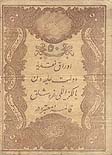
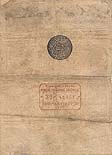
Ottoman
banknote series 1877
In 1863 the Empire
Ottoman Bank was established and it had the rights to issue banknote (kaimeta).
But the first Turkish paper money failed, because the Bank was very far
and the traveling to it was very expensive and dangerous. Despite the
enormous gold holding of the Bank the exchange of banknote was practically
impossible. The people didn't trust those "paper pieces", and didn't accept
them as units of currency. During that period different kinds of silver
coins went into circulation and the gold (pendaras) were used in the most
important deals. We should not forget that the barter deals were still
the great percent in the trading.
After 1864 the
reforms on the territory of Bulgaria were felt considerably when Midhad
Pasha was appointed as a governor of the Danube Vilayet. He made special
efforts to Europeanize not only the administrative center Rouse but he
also organized roads' building in North Bulgaria. In 1866 the first railway
line was opened up. It connected Rouse and Varna. Shortly afterwards the
other two railway lines were finished off. (Tarnovo - Jambol, Thessalonica
- Skopie). Also, Midhad Pasha promoted the establishment of the so-called
agrarian funds. Their main function was to give assistance to the people
because the money lending was still in its prosperity. On the other hand
in 1864 a special law was passed fixing the interest between 12 % and
15%.
The first fund was established in 1864 with obligatory
fees paid in agrarian production. The collected cereals and other agricultural
products were sold and the money was lent at 12 % minimum lawful interest.
In fact the agrarian finds were the first credit organizations in Bulgaria.
Up to 1876 the facts suggested that those funds had at their disposal
working capital of 66 000 groshes annually.
The first credit institution before the Liberation on
the territory of Bulgaria was established in Varna in 1869. It was named
"The Bulgarian Trading Society "and its chief activity was to lend money
at interest. Its finds increased gradually and in 1872 it had at its disposal
250 000 groshes.
Some of the well of and better-prepared Bulgarians bravely
embarked on joint-stock companies and credit affairs. In the last two
decades of the Ottoman Yoke on our lands about 40 joint-stock companies
were found including shipping one. There were some attempts for establishing
of Bulgarian banks in Plovdiv and Gabrovo, but they failed.
The Bulgarian traders achieved good results in doing
business with neighboring and other countries. Thus for instance in 1869
the firm of the Tapchileshtovi brothers had at its disposal a capital
of 5090865 groshes that increased every other year.
On the eve of the Liberation together with the firm
of the Tapchileshtovi brothers other firms did a brisk trade too. Such
firms were those of Evlogy and Christo Georgievi, the Toshkovi, the Geshovsi
and etc. The number of the manufacture enterprises reached 500 and that
of functioning factories - 11.
Despite all some
of the reforming measure in the policy of the Sublime Porte had a stimulating
effect on the development of the agriculture, trade and manufacture production
in Bulgarian lands. The changes are indisputable compare to the previous
centuries but as a whole the economic initiative among the Bulgarians
didn't succeed in building a modern agriculture and industry until the
Liberation.
The foreign political dominance ensured neither the free
flow of capitals nor the development of private property. That inevitably
slowed up the speed of the social-economic changes in the Bulgarian society
and had a negative influence on the progress and the final results of
all other processes during the Bulgarian National Revival.